
The average B2B purchase now involves around 13 people across several departments, and most of the decision is made before anyone talks to you. Why single-threaded deals stall, how to map a buying group, and a simple coverage check that shows which deals are at risk.

In this article 9 sections
Most outbound systems are built around a single person. A lead gets scored, a lead gets a sequence, a lead replies, a lead becomes the contact on an opportunity. The CRM, the dashboards and the rep's habits all point at one name.
But that one name rarely makes the decision. The person who replied to your email is usually one voice in a group, and often not the one who signs. When that person goes quiet, changes jobs or loses the internal argument, a deal with one thread simply stops.
This article covers how big buying groups have become, how late you enter their process, and a practical way to map and track every deal by the group rather than the lead.
How many people are actually involved
Forrester's 2024 State of Business Buying research found that on average 13 people are involved in a B2B purchase, and that 89% of purchases involve two or more departments (Forrester).
Thirteen people is not thirteen fans of your product. It includes the people who will use it, the people who have to integrate and secure it, the people who will pay for it, and the people whose work changes because of it. Each of them can slow the deal down or stop it.
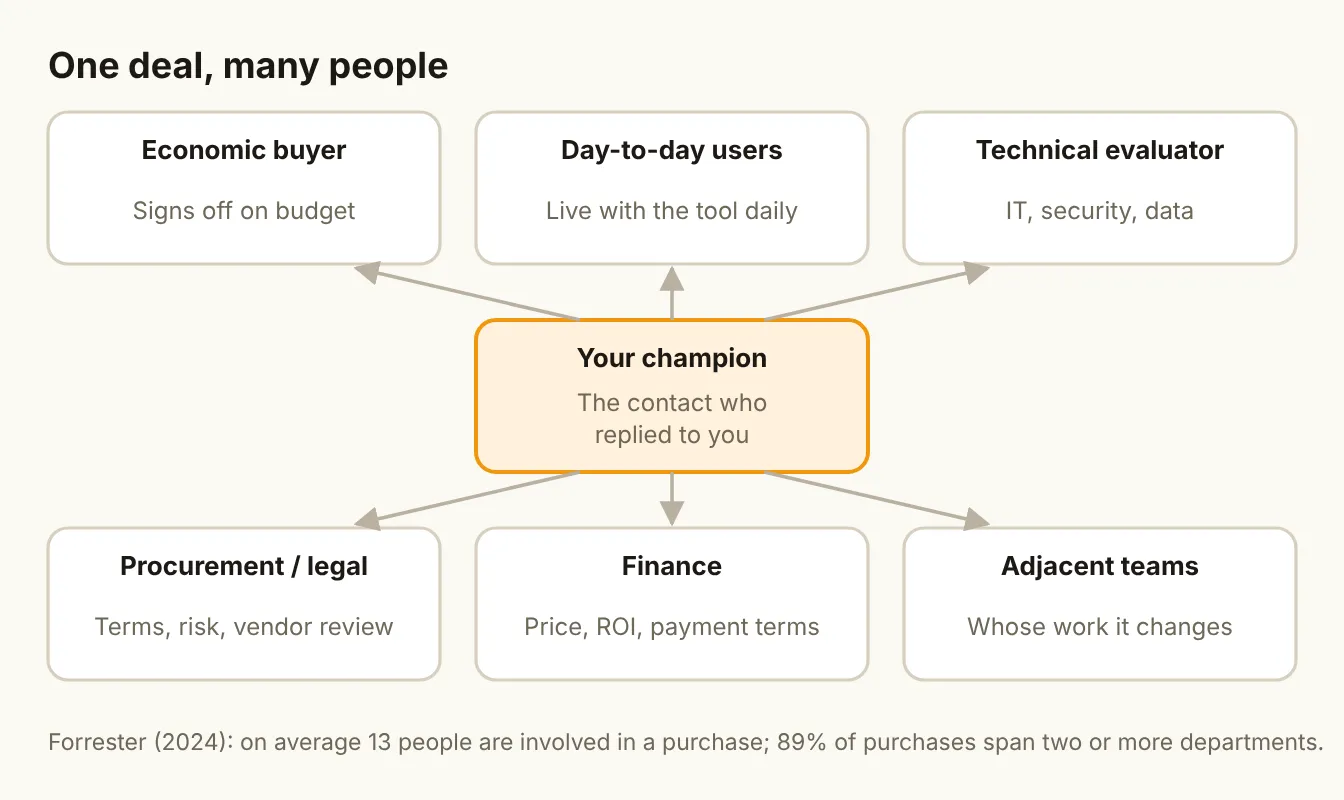
The roles vary by deal, but most buying groups include some version of:
- Champion: the person who wants this to happen, usually your first contact.
- Economic buyer: the person who signs off on budget.
- Day-to-day users: the people who will live with the tool.
- Technical evaluator: IT, security or data, checking that it fits and is safe.
- Procurement or legal: terms, risk and vendor review.
- Finance: price, return on investment and payment terms.
- Adjacent teams: anyone whose work the purchase changes.
You arrive late, and the shortlist is already written
The group size would be manageable if you met them early. You usually don't.
The 6sense 2025 B2B Buyer Experience study, based on about 4,000 buyer responses, found that buyers first contact a seller roughly 61% of the way through their buying journey, earlier than the 69% found the year before, but still well past halfway. 79% of the time, it was the buyer who reached out, not the seller (CustomerThink).
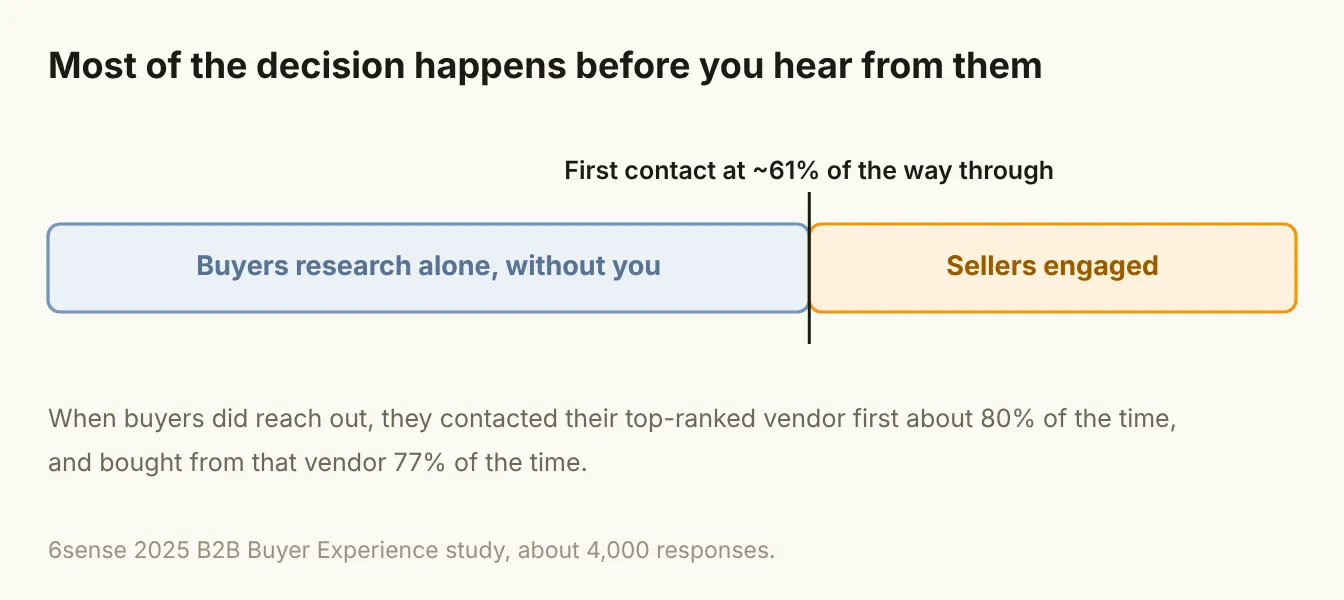
The same study found buyers evaluated about five vendors, and four of those five shortlist spots were filled on day one. When buyers did reach out, they contacted their top-ranked vendor first about 80% of the time, and bought from that vendor 77% of the time (CustomerThink).
Put that together with the group size. A group of around a dozen people does most of its research before speaking to you, and mostly decides who it prefers in that time. Reaching one person in that group, late, is a weak position.
Buyers are also not asking for more reps. Gartner found that 61% of B2B buyers prefer a rep-free buying experience overall, and 73% actively avoid suppliers who send irrelevant outreach (Gartner). Multithreading does not mean blasting everyone at the account. It means being useful to each role, through the right channel, at the right time.
Why single-threaded deals stall
When your only contact is the champion, the deal depends on them doing three jobs at once: understanding your product, explaining it to colleagues who care about different things, and winning the internal argument. Most champions are good at the first and unprepared for the other two.
Common ways a single-threaded deal dies:
- The champion leaves or changes role. The deal leaves with them.
- Someone you never met says no. Security, finance or a peer team raises a concern nobody answered.
- The deal loses to "do nothing." Without anyone senior pushing, the project slips to next quarter, then disappears.
- The buyer regrets it. Forrester found 81% of purchasers expressed dissatisfaction with the provider they chose (Forrester). Groups that weren't consulted during the purchase are a likely source of that regret, and of churn at renewal.
How to map a buying group
You don't need a new tool to start. You need a habit and a few CRM fields.
1. List the roles for this deal. Use the list above and adjust it to what you sell. A product that touches customer data needs security. A product that changes how a team works needs that team's manager.
2. Ask the champion. The best source of the map is the person who wants the deal to happen. Questions that work: "Who else will need to agree to this?", "Who was involved last time you bought something like this?" and "Who could stop this?"
3. Fill gaps from data. Use Sales Navigator or an enrichment tool such as Clay to find people in the roles your champion mentioned. Intent and account-identification platforms such as 6sense can show which other people or teams at the account are researching the problem, which is a useful hint about who is already in the group.
4. Record it on the deal, not the contact. In HubSpot, Salesforce or whatever CRM you use, associate every known person with the opportunity and give each one a role. A deal with one associated contact should look different in your pipeline from a deal with five.
A coverage check for every deal
Once roles are recorded, you can see the gaps at a glance.
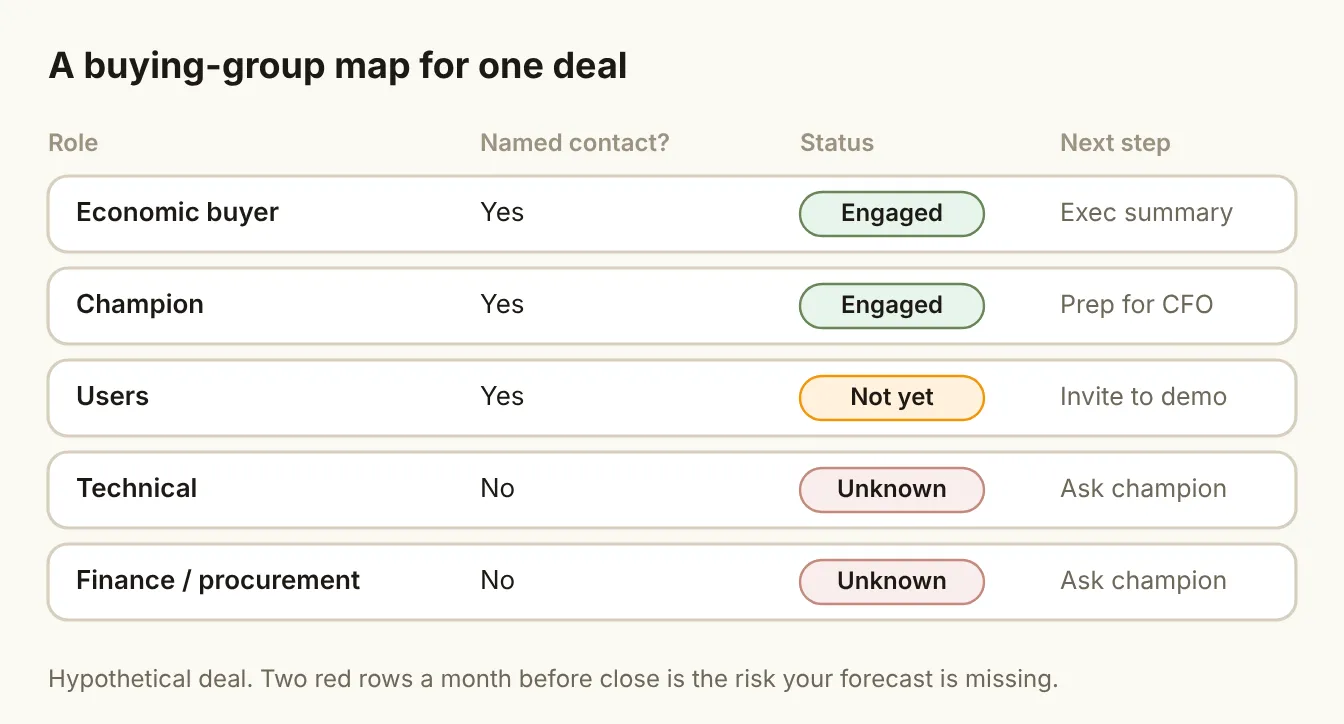
For each open deal above a certain size, track four things per role:
- Named contact? Do you know who holds this role?
- Status: engaged, not yet contacted, or unknown.
- Last meaningful touch: a reply, a meeting or a document they read.
- Next step: what each role needs from you, and who on your side owns it.
Then review it in pipeline meetings. A deal forecast to close this month with no named economic buyer, or with nobody from security or finance, is a forecast risk, whatever stage it says it is in.
What to send each role
Multithreading works when each person gets something that helps them, not the same sequence with a different first name.
| Role | What they care about | What helps them |
|---|---|---|
| Economic buyer | Outcome, cost, risk | A one-page business case the champion can forward |
| Users | Will this make my week easier? | A short demo of their actual workflow |
| Technical evaluator | Security, integration, data | Security documentation and an integration overview, sent before they ask |
| Finance and procurement | Price, terms, vendor risk | Clear pricing, standard terms and a simple ROI estimate |
| Adjacent teams | What changes for us? | A short note on impact, via the champion |
Two rules keep this from becoming spam. First, go through the champion where you can. Ask them to introduce you, or give them the material to forward. Second, every message should answer that role's question, not repeat your pitch.
Changing the system, not just the habit
Reps can learn to multithread. But if your systems still count leads, they will keep working leads. A few changes help:
- Score and route accounts, not just people. Several people from the same account showing interest is a stronger signal than one person showing a lot. Your scoring rules should say so.
- Report coverage. Add "contacts engaged per open deal" to the pipeline review, next to amount and stage.
- Enrich around the reply. When someone at a target account replies, find the other likely roles at that account automatically and add them to the deal for the rep to review.
- Make the map part of stage criteria. For example, a deal can't move to proposal without a named economic buyer.
The bottom line
Your buyer is a group of around a dozen people across several departments, who do most of their research before they speak to you and usually have a favorite by then. A single contact can't carry that group for you. Map the roles on every deal, track who is engaged, give each role what it needs, and treat missing roles as the forecast risk they are.