Buyers increasingly skip reps, and they punish the ones who show up unprepared. A seven-part, one-page brief that builds itself when a meeting is booked, so every rep walks in knowing why the buyer is there.

In this article 8 sections
A meeting gets booked. The rep sees it on their calendar the morning of, opens LinkedIn two minutes before the call, skims the prospect's headline, and starts with "So, tell me a bit about what you do."
The buyer already told you. They filled in a form, replied to an email or spoke to a colleague of yours last year. The information exists, scattered across your CRM, your inbox and the open web. It just never reached the rep in a form they could use.
The fix is not "do more research." Reps don't have time, and the research they do is inconsistent. The fix is one standard page, built automatically when the meeting is booked, that a rep can read in two minutes.
Why the meeting you get has to count
Buyers are telling us, clearly, that they would rather not meet a rep at all.
Gartner's survey of 632 B2B buyers found that 61% prefer an overall rep-free buying experience. In the same survey, 73% said they actively avoid suppliers who send irrelevant outreach, and 69% reported inconsistencies between what a supplier's website says and what its sellers tell them (Gartner).
Read those together. Buyers come to the meeting having already done their homework, they are allergic to generic pitches, and they notice when your rep doesn't know what your own website says. The rare meeting you do get is the one place you can't afford to look unprepared.
Understanding the buyer's business is not a nice-to-have, either. In a LinkedIn State of Sales survey of 800 North American B2B buyers, 44% said they would not buy from a rep who doesn't understand their needs (MarketingCharts). That survey dates from around 2021, but the point has only become sharper as buyers do more of the work alone.
The one page, section by section
A good brief is short, standard and specific. Short, so it gets read. Standard, so a manager can check it and a rep knows where to look. Specific, so it changes what the rep says in the first five minutes.
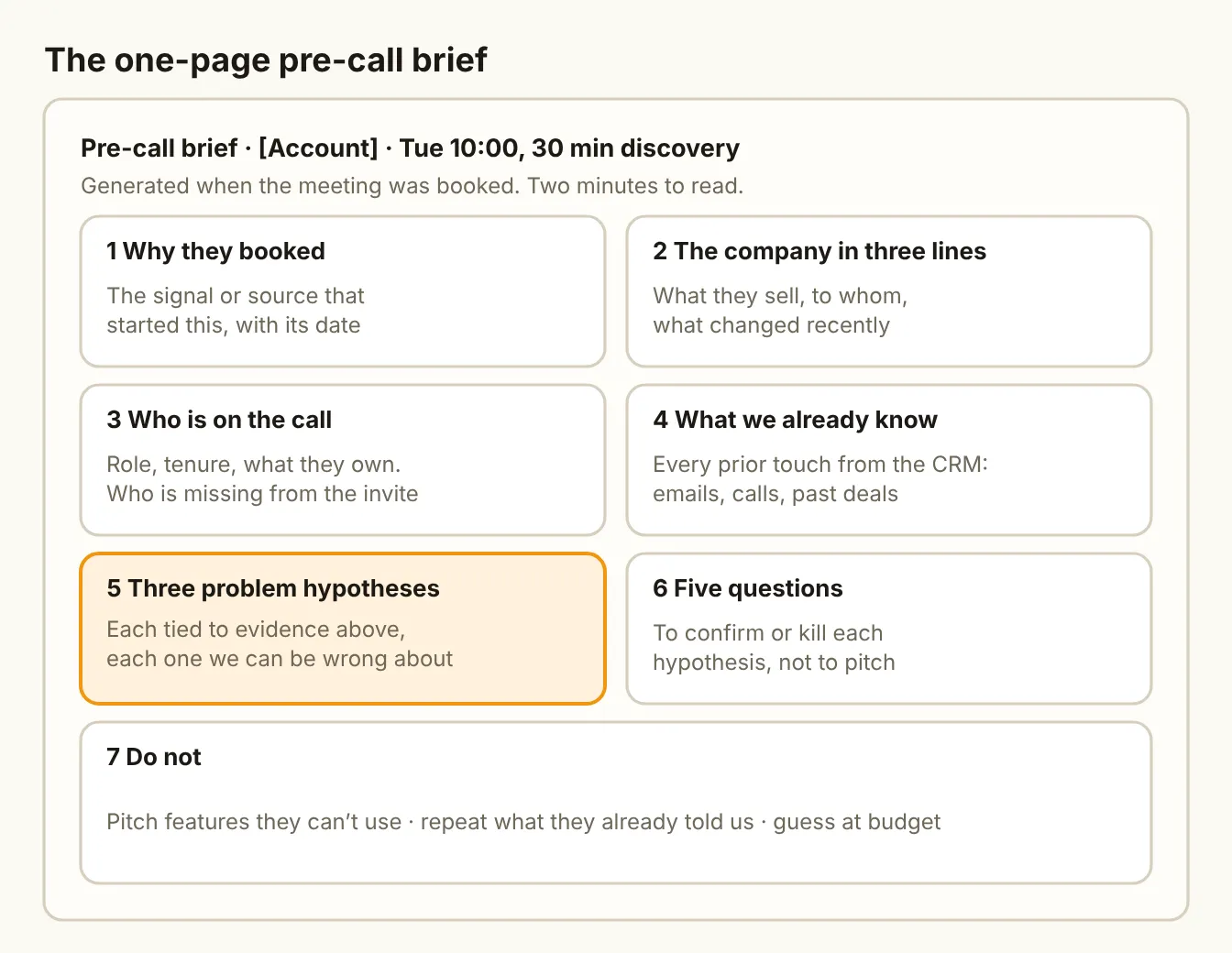
1. Why they booked. The single most useful line on the page. Which signal, form, reply or referral started this, and when? "Requested a demo from the pricing page on Tuesday after two visits" is a completely different call from "accepted a cold meeting from a sequence." If your CRM records the original source and signal for every lead, this section writes itself.
2. The company in three lines. What they sell, who they sell to, and what changed recently: a funding round, a new product, a leadership hire, a hiring push in a relevant team. Three lines, not a Wikipedia summary.
3. Who is on the call, and who isn't. Each attendee's role, how long they have been in it and what they likely own. Then the gap: if you sell to the head of RevOps and only an analyst accepted, note it. That gap becomes a question.
4. What we already know. Every prior touch from your CRM: past emails, calls, closed-lost deals, support tickets, product usage. Nothing damages trust faster than asking a buyer to repeat what they told your colleague six months ago.
5. Three problem hypotheses. This is the heart of the page. Based on sections 1 to 4, what are the three most likely problems this buyer is trying to solve? Each should be tied to evidence above and each should be something the rep could be wrong about.
6. Five questions. Questions that confirm or kill each hypothesis. Not "what keeps you up at night," but "you've hired three SDRs since June; how are you deciding which accounts they work?"
7. Do not. Two or three things to avoid: features they can't use on their plan, topics they already covered with a colleague, guesses at budget. A short "don't" list prevents the most common unforced errors.
Why hypotheses and questions, not a pitch
Sections 5 and 6 are where the brief earns its keep, and there is data behind the structure.
Gong analyzed 519,000 recorded discovery calls and found that the most successful ones uncovered 3 to 4 business problems and included 11 to 14 questions. Fewer questions felt thin; more started to feel like an interrogation (Gong). That analysis was first published in 2017 and comes from a vendor, so treat the exact numbers as a guide, not a rule. But it matches the brief's shape: a few clear hypotheses, a handful of prepared questions, and room for the follow-ups that come naturally.
A brief that arrives with hypotheses turns discovery from "tell me about yourself" into "here's what I think is going on; tell me where I'm wrong." Buyers who have done their own research respond to that far better than to a generic script.
How the brief builds itself
The brief only works if nobody has to remember to make it. Trigger it from the booking.
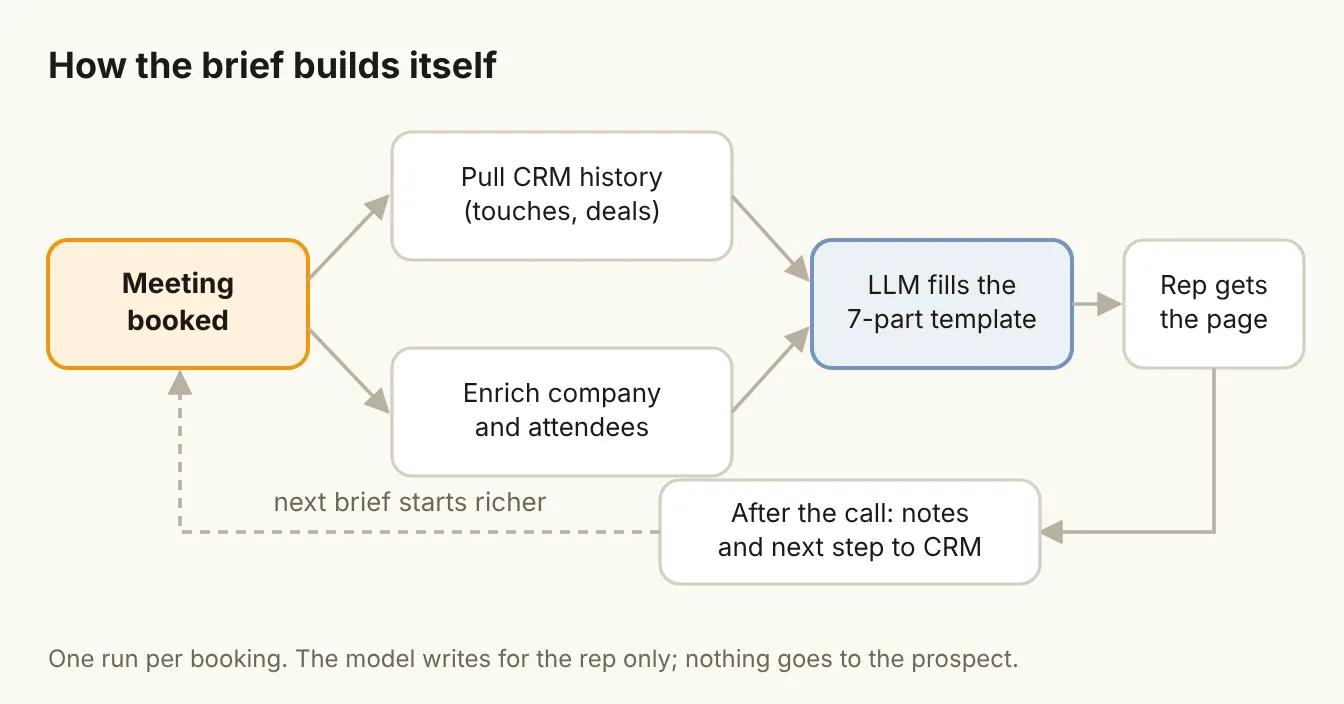
A practical build in n8n, or any workflow tool you already use:
- Trigger on a booked meeting. A new event on the rep's calendar with an external attendee, or a booking from your scheduling tool.
- Pull CRM history. Find the company and contacts, and fetch past activities, open and closed deals, the original lead source and any recorded signals.
- Enrich in parallel. Company firmographics and recent changes, and each attendee's role and tenure. A Clay table or your enrichment provider of choice works here.
- Fill the template with an LLM. Pass everything from steps 2 and 3 into a prompt that writes the seven sections, using only the facts it was given. Tell it to write "unknown" rather than guess.
- Deliver it to the rep. Post it to Slack, email it or attach it to the calendar event, at booking time and again an hour before the call.
- Close the loop after the call. Your meeting recorder (Avoma, Fathom or similar) pushes notes and next steps back to the CRM, so the next brief for this account starts richer.
This is a workflow, not an agent: the steps are fixed and the model does one job, filling a template from facts you hand it. If you are unsure where that line sits, see You probably don't need an AI agent.
Three rules for the AI step
- Facts in, facts out. The model should only use the data the workflow fetched. No browsing, no inventing, and "unknown" is an acceptable answer.
- The rep is the only reader. The brief never goes to the prospect. That removes most of the risk of an AI mistake reaching a buyer.
- Keep the template fixed. Same seven sections every time. Consistency is what lets a rep read it in two minutes and a manager review it in one.
How to roll it out
- Week 1: write the template by hand. Have two reps fill in the seven sections manually for their next five meetings. Cut anything they didn't use.
- Week 2: automate the data pull. Build steps 1 to 3 so the raw facts arrive automatically. Reps still write sections 5 to 7 themselves.
- Week 3: add the AI step. Let the model draft the whole page. Reps edit it before the call and flag anything wrong.
- Week 4: inspect. Managers spot-check briefs in deal reviews. Did section 5 match what the buyer actually said? Adjust the prompt and the data sources accordingly.
What to measure
You won't get a clean A/B test on call quality, but you can track signals that move:
- Brief coverage: the share of booked meetings that had a brief before the call.
- Meeting-to-next-step rate: how often a first meeting leads to a second.
- Hypothesis hit rate: in reviews, how often at least one hypothesis in section 5 was confirmed.
- Repeat questions: buyer complaints or notes like "already told your colleague," which should fall toward zero.
The bottom line
Buyers will give you fewer meetings than they used to, and they will judge you on the first five minutes. A one-page brief, built from what you already know and delivered before the rep needs it, is the cheapest way to make every one of those meetings count.