
GTM engineer is one of the fastest-spreading titles in B2B, and one of the least defined. What the job ads actually ask for, how the role differs from RevOps and sales ops, what it pays, and the signs your team needs one.

In this article 10 sections
A few years ago, "GTM engineer" wasn't a job title anyone hired for. Today it shows up across B2B job boards, often with "founding" in front of it. Ask five companies what the role does and you will get five answers: a Clay expert, a RevOps person who can code, an SDR manager with a Zapier habit, a growth engineer pointed at sales.
This is the working definition this site uses, built from what companies actually put in their job ads, plus a simple test for whether your team needs one yet.
The short definition
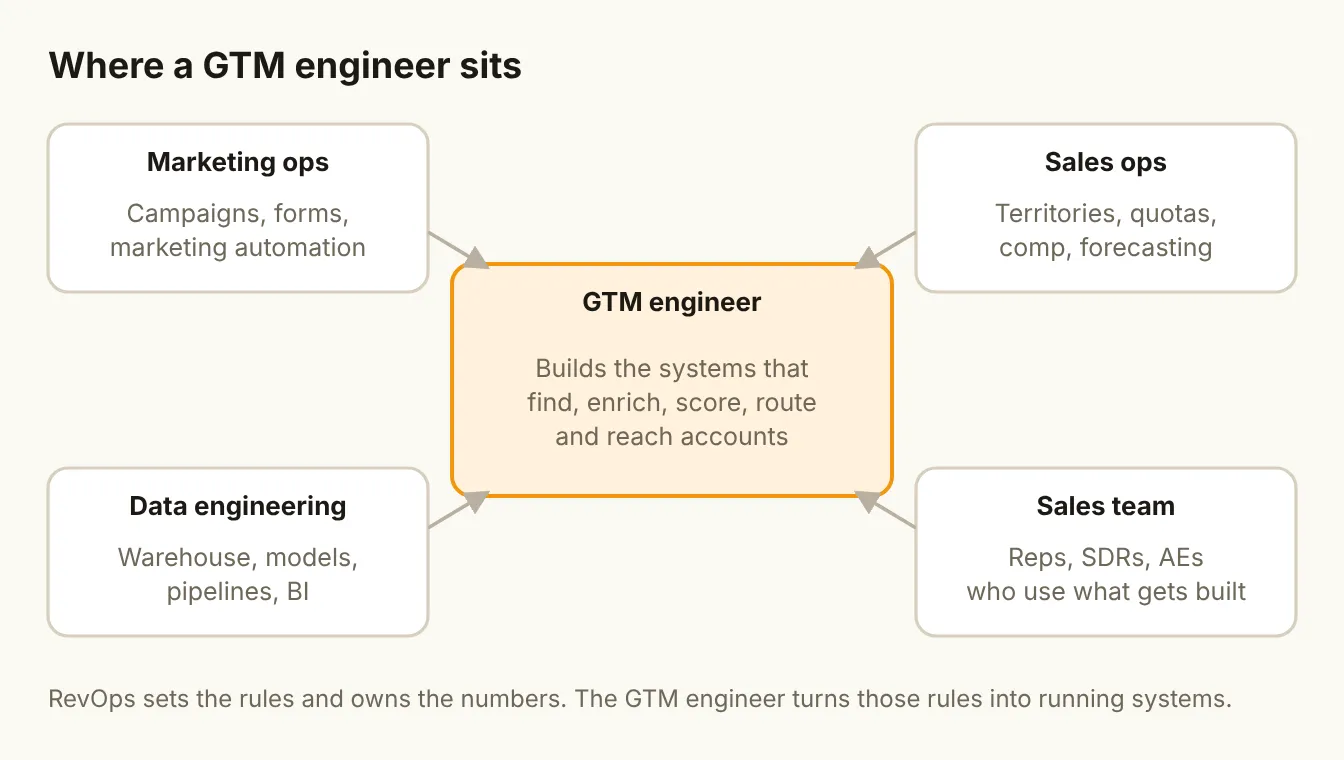
A GTM engineer builds the systems that find, enrich, score, route and reach the right accounts, so that sellers spend their time on conversations instead of spreadsheets.
Two words matter in that sentence. Builds: the role ships working systems, not slide decks or process docs. Systems: the output is something that keeps running after the person who built it goes home, such as an enrichment table, a routing workflow or a scoring model.
What the job ads actually ask for
An analysis of more than 100 GTM engineer job ads posted between January and June 2026, mostly at Series A to C B2B software companies in the US and Europe, gives the clearest picture of what employers want (Cremanski). The most common responsibilities were:
- Building and maintaining automated prospecting and data workflows
- Designing CRM data architecture: field mapping, lifecycle stages, lead routing
- Integrating LLM APIs for personalization and account research
- Owning attribution and analytics infrastructure
- Automating outbound sequences and SDR-assist workflows
- Building lead scoring models
- Sourcing total-addressable-market lists and lookalike audiences
The tools mentioned tell the same story. The analysis gives approximate shares of ads:
| Skill or tool | Share of ads (approx.) |
|---|---|
| Workflow automation (Make, n8n, Zapier) | ~85% |
| CRM administration (HubSpot, Salesforce) | ~80% |
| Clay or another enrichment platform | ~75% |
| LLM or AI API integration | ~65% |
| Intent signal platforms | ~55% |
| Attribution and analytics | ~45% |
| Python, SQL or JavaScript | ~40% |
That AI line is going to grow. Gartner forecasts that by 2027, "95% of sellers' research workflows will begin with AI," up from under 20% in 2024. The same release found sales organizations that give sellers AI-enabled next-best-action guidance are 2.6 times more likely to achieve commercial growth (Gartner). Someone has to build and maintain the systems that put that guidance in front of sellers. That is GTM engineering.
Notice the last row of the table, too. Fewer than half the ads ask for a programming language. The role is defined by building systems, not by writing code, although the ability to script is a clear advantage as more of this work moves into coding agents.
Where the week goes
The same analysis estimates how the time splits across a typical week.
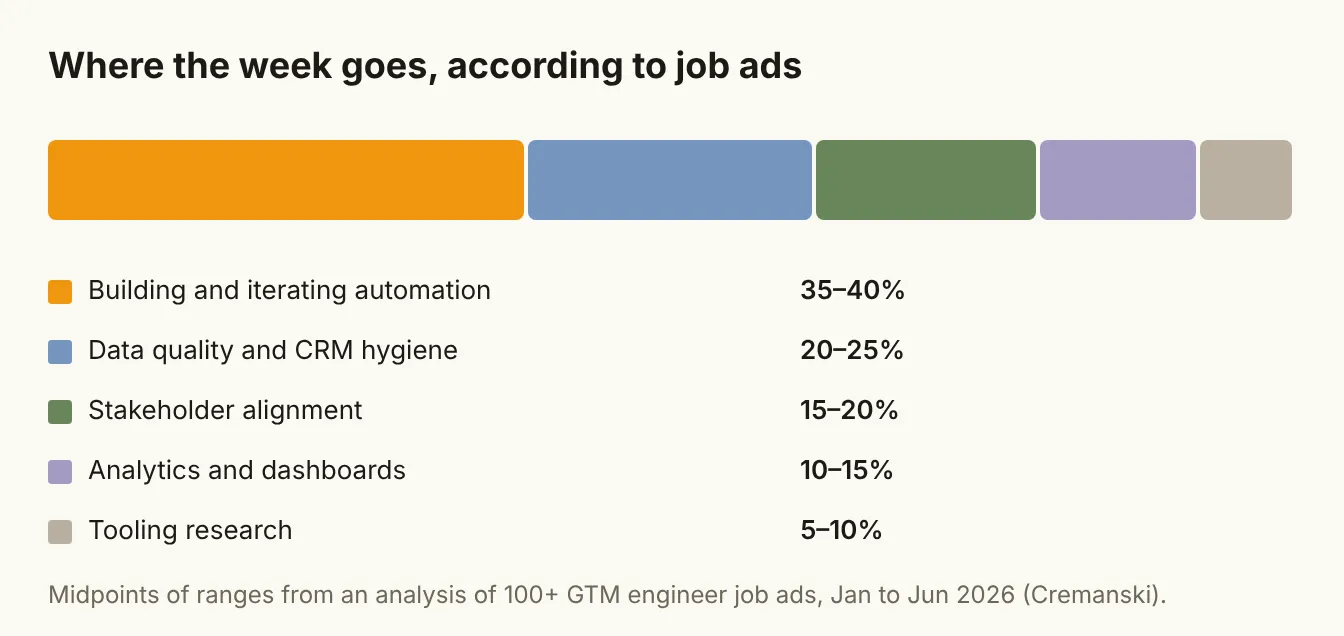
Two things stand out. Building is the biggest slice, but not the majority of the job. And data quality and CRM hygiene take roughly a quarter of the week. A GTM engineer who only builds new things, and never maintains the data underneath them, ends up with impressive workflows producing bad output.
GTM engineer vs RevOps vs sales ops
The titles overlap, and at small companies one person often does all three. The distinction that holds up best is about what each role produces:
| Role | Main question | Typical output |
|---|---|---|
| Sales ops | How is the sales team organized and paid? | Territories, quotas, comp plans, forecasts |
| Marketing ops | How do campaigns run and get measured? | Forms, nurture programs, campaign attribution |
| RevOps | What are the rules and numbers across the funnel? | Definitions, stage criteria, reporting, process |
| GTM engineer | How do we turn those rules into running systems? | Enrichment, scoring, routing and outreach workflows |
Put simply, RevOps decides what a qualified account is and how a lead should be routed. The GTM engineer builds the thing that does it, thousands of times a day, without anyone touching a spreadsheet.
What it pays
Where salaries were disclosed in the job ads analysis, US individual-contributor GTM engineer roles ranged from about $120,000 to $200,000 a year. Mid-level roles (two to five years of experience) at Series A and B companies clustered around $130,000 to $170,000, and senior or founding roles around $160,000 to $200,000 plus equity. European roles ran roughly 20 to 30% lower (Cremanski).
The same analysis found roughly 30% of ads used the "Founding GTM Engineer" title, and that most asked for two to five years of experience in RevOps, growth engineering, marketing ops or sales ops. That is the usual path into the role: someone from operations who started automating their own work.
When you need one
You don't need a GTM engineer to start outbound. A founder with a CRM, a data tool and a sequencer can get a long way. You need one when the manual work starts to cost more than the person would.
The signs:
- Reps or SDRs spend hours a week building lists. Research, enrichment and copy-pasting into the CRM are eating selling time.
- You have signals you can't act on. Website visits, job changes or product sign-ups are visible somewhere, but nobody turns them into a timely action.
- Your data tools don't talk to each other. Enrichment results live in one tool, the CRM says something else, and the sequencer has a third version.
- Routing is a person. Someone manually decides who gets each lead, and leads wait while they do.
- You've bought AI tools nobody has wired in. Licenses for enrichment, research or agent tools exist, but they aren't connected to the workflow the team actually uses.
If three or more of those are true, the role will likely pay for itself in rep time alone.
What to look for when hiring
- Evidence they have shipped systems. Ask for something they built that ran without them: a workflow, a table, a scoring model. Ask what broke and how they found out.
- Judgment about what not to automate. The best GTM engineers can explain why a step should stay manual, especially anything a buyer sees.
- Data discipline. Ask how they kept a CRM clean. A builder who doesn't care about data quality will automate the mess.
- Comfort with the tools your team already uses. Workflow tools like n8n, enrichment platforms like Clay and your CRM, whether that is HubSpot or something else. Increasingly, coding agents like Claude Code as well.
- Someone who talks to reps. The system only works if the people using it trust it. Stakeholder alignment is close to a fifth of the job for a reason.
The first 90 days
A useful first-quarter plan for a new GTM engineer:
- Weeks 1 to 4: Audit. Map every tool, data source and manual step from first signal to booked meeting. Write down the ICP and routing rules as they actually work today.
- Weeks 5 to 8: Fix the foundation. Clean the CRM fields that matter, set up enrichment with verification, and automate routing.
- Weeks 9 to 12: Build one signal-to-meeting workflow. Pick the strongest signal you have, and build the full path from signal to a rep-approved first touch. Measure meetings from it.
One working system that reps use beats ten clever ones they ignore.
The bottom line
A GTM engineer is the person who turns your go-to-market rules into systems that run on their own. The title is new and still fuzzy, but the job ads agree on the core: automation, CRM architecture, enrichment and, increasingly, AI. Hire one when manual list-building, unacted signals and disconnected tools are costing your sellers more time than the role costs you.