
The GTM edge in late 2026 no longer comes from owning more tools or sending more messages. It comes from deciding what to build, who to reach, and when, then letting agents do the rest.

In this article 6 sections
On September 9, Clay raised a $115M Series D at a $7.1B valuation, led by Wellington with Sequoia, a16z and CapitalG participating (SiliconANGLE). That is more than double its $3.1B price from August 2025. Clay now reports over 17,000 customers and is putting $1M into training GTM engineers, the role it named (The Next Web).
The headline is the money. The signal is what Clay says it is building: a self-learning revenue engine, not a better spreadsheet. The whole market is moving the same way. Here are the four shifts behind it, and what they mean for how you run go-to-market this quarter.
Shift 1: The build layer moved into coding agents
The GTM engineer's main workbench is now a coding agent, not a visual canvas. Adoption of Cursor and Claude Code among GTM engineers sits near 70% in 2026, roughly where Clay adoption was two years ago (Reachly).
The story of the last nine months is migration and return. Early Clay power users rebuilt their table logic in Claude Code. Clay answered by shipping an API, a CLI and an MCP server, and some of those users came back (AI Builder Club).
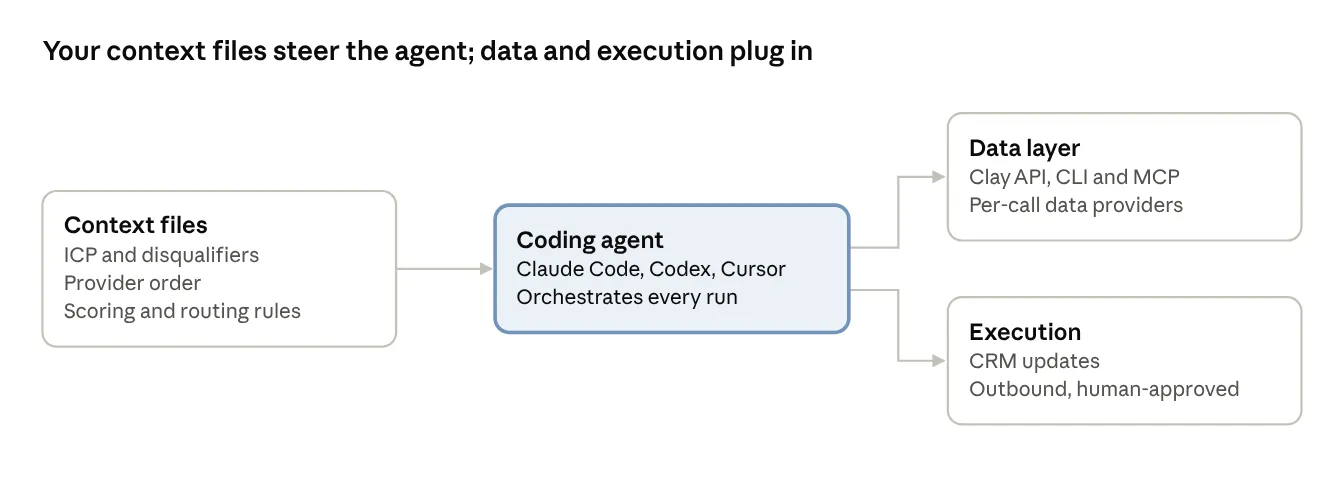
The useful way to read this: Clay is a data layer, and a coding agent is a builder. What moved to Claude Code was mostly the logic wrapped around the data, meaning scoring rules, routing and table logic, not the enrichment waterfall itself (Ziellab).
What it means: stop asking "Clay or Claude Code?" Put your ICP definition, provider order, field mappings and scoring rules in version-controlled context files. Let the agent orchestrate. Buy data per call where you can. Your moat is the context, not the canvas.
Shift 2: Volume became a liability
AI SDRs made sending cheap, and the inbox priced it in. Woodpecker's data across more than 20 million emails shows average cold reply rates falling from 5.1% in 2024 to 3.43% in 2026 (Koka Sexton).
The reply gap between AI and human copy is actually small. One 100K-email analysis found 4.1% for AI versus 5.2% for human. The real cost is deliverability: AI emails were flagged as spam at 8% versus 3% for human sends (Digital Applied). Burn your domains and every future campaign pays for it.
The spread between average and elite senders is now the widest it has been. Senders who genuinely research every contact still report 17 to 18% reply rates, against 7 to 9% for everyone else (Koka Sexton). Tight ICPs also hold up far better than broad ones.
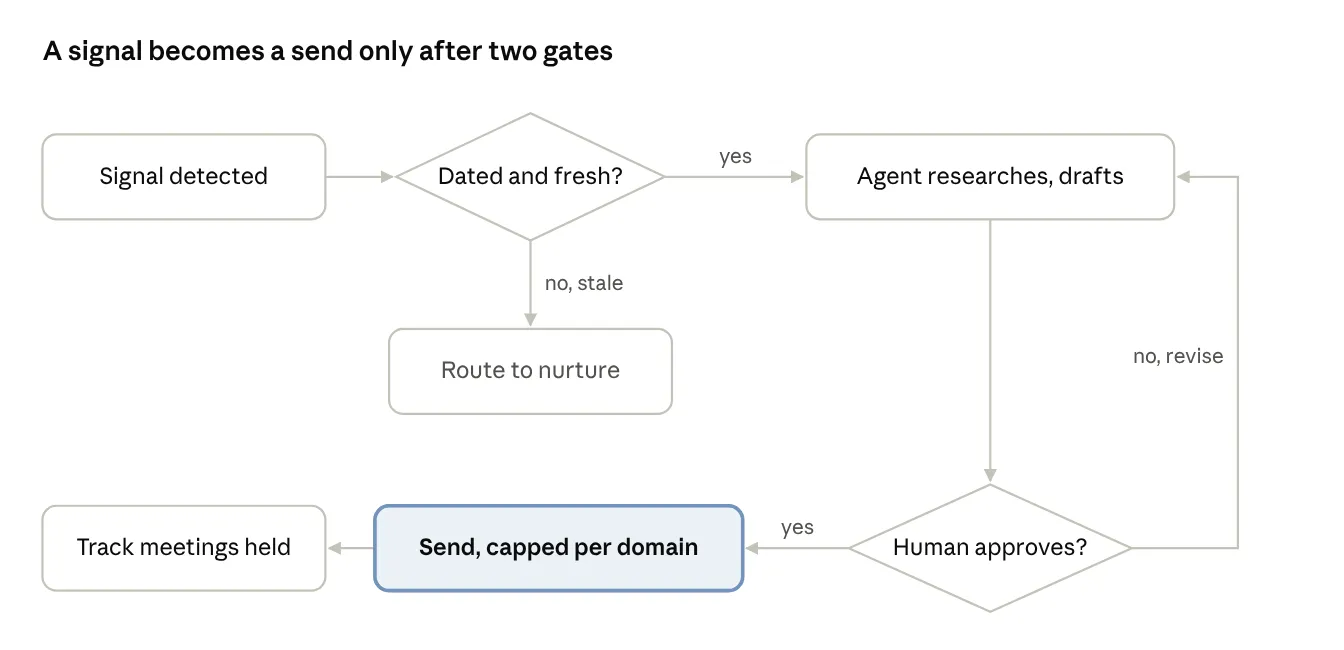
What it means: the autonomous AI SDR pitch is fading. The model that works is hybrid. Agents research and draft, a human approves anything that leaves the building, and someone owns sender reputation as a KPI. Cap volume per domain. Measure positive replies and meetings, not sends.
Note: most of these benchmarks come from vendors with a stake in the answer. Treat the exact numbers as directional and test against your own baseline.
Shift 3: The first touch is an AI answer
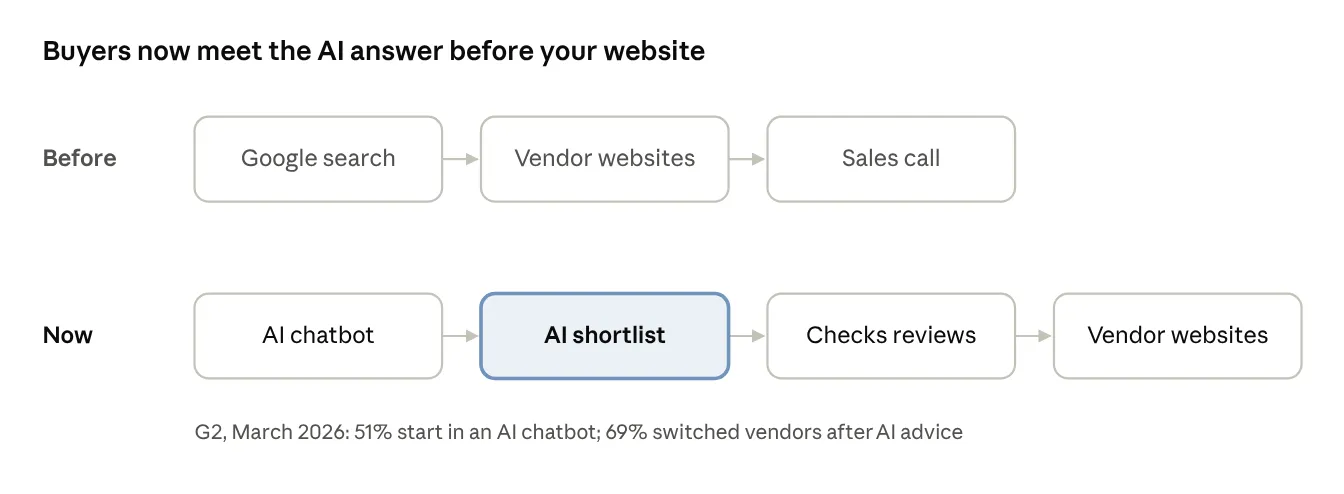
Your buyer's shortlist is increasingly written by a chatbot before they ever hit your site. G2's March 2026 survey of 1,076 buyers found 51% now start software research with an AI chatbot more often than Google (G2).
It changes outcomes, not just habits. In the same survey, 69% said AI guidance led them to a different vendor than planned, and a third bought from a vendor they had never heard of (Demand Gen Report). Forrester's survey of 18,000 buyers found 94% used AI in their most recent purchase (Machine Relations).
What it means: answer engine optimization is now a pipeline channel, not an SEO side project. Publish plain comparison pages, honest pricing context and specific use-case proof. Earn reviews and third-party mentions, since buyers check citations before trusting an AI answer. Then track how often assistants name you, the way you track rankings.
Shift 4: Signals need a date and an order
Everyone is signal-based now, so the edge is signal hygiene. The unit of work has moved from a list to a signal: a hire, a funding round, a tech change, a pricing-page visit (DevCommX).
Two practitioner rules are worth stealing. First, there is no best data provider, only the best order to try them in. Second, keep the date next to every finding, so a hiring post from March does not trigger a campaign in September (AI Builder Club).
What it means: give every signal a timestamp, a source and an expiry. Rank providers by hit rate and cost per verified field, not by brand. Route stale signals to nurture, not to a sequence.
The Q4 playbook
Put together, the new GTM algorithm is simple: fewer sends, better timing, and a context layer only you own. Five moves for the rest of the year:
- Write down your context. ICP, disqualifiers, provider order, scoring and routing rules, in files your agents read on every run.
- Audit your sends. Cut any campaign with no dated signal behind it. Cap volume per domain and put sender reputation on the dashboard.
- Keep a human at the gate. Agents research and draft. A person approves outbound and owns reply triage.
- Get cited. Ship comparison and use-case pages, earn reviews, and check monthly what AI assistants say about your category.
- Measure what matters. Positive reply rate, meetings held and pipeline per signal type, not emails sent.
The teams that win this cycle will not have the biggest stack. They will have the clearest judgment, encoded where their agents can use it.
Sources
- SiliconANGLE: Clay raises $115M at $7.1B
- The Next Web: Clay Series D and GTM engineer training fund
- AI Builder Club: What GTM engineers build in 2026
- Reachly: The complete 2026 GTM engineering guide
- Ziellab: Claude for GTM
- Koka Sexton: AI SDRs and the signal-first fix
- Digital Applied: AI SDR 100K email analysis
- G2: 2026 AI Search Insight Report
- Demand Gen Report on the G2 survey
- Machine Relations: Forrester 2026 buyer survey
- DevCommX: GTM engineering trends 2026